OVN-Kubernetes Architecture
OVN-Kubernetes uses interconnect mode, a distributed control plane
architecture. The control-plane components run in the
ovnkube-control-plane pod, while OVN databases, northd, and node-local
controllers run per zone in the ovnkube-node pods.
OVN-Kubernetes Components
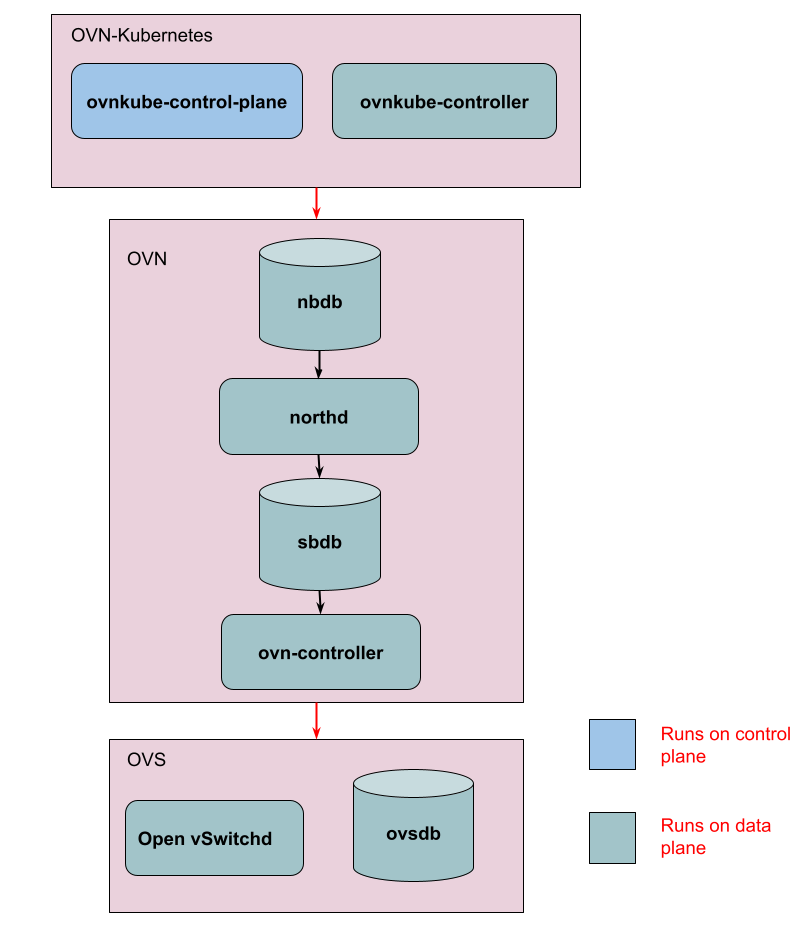
The control plane has the ovnkube-control-plane pod in the ovn-kubernetes namespace
which is super lightweight and running only on the control plane nodes in your cluster:
- ovnkube-control-plane pod
- ovnkube-cluster-manager container:
- OVN-Kubernetes component
- Watches K8s API for objects - nodes mainly
- Allocates pod subnet to each node
- Allocates join subnet IP to each node
- Allocates transit subnet IP to each node
- Consolidates zone statuses across all nodes for features like EgressFirewall and EgressQoS
- ovnkube-cluster-manager container:
- ovnkube-identity pod
- Runs only on control-plane nodes
- Provides certificate-based identity for node authentication
- Ensures requests from ovnkube-node pods are authenticated and authorized
The data plane includes the ovnkube-node and ovs-node pods in the ovn-kubernetes
namespace running on all your nodes in the cluster making this architecture localized
and more distributed.
- ovnkube-node pod
- ovnkube-controller container:
- OVN-Kubernetes component
- Allocates podIP from the podSubnet to each pod in its zone (IPAM)
- Watches K8s API for objects - nodes, namespaces, pods, services, endpoints, network policies, CRs
- Translates K8s objects into OVN logical entities - stores them in OVN databases
- Stores OVN entities in NorthBound Database (NBDB)
- Manages pod subnet allocation to nodes (pod IPAM)
- Runs the CNI executable (CNI ADD/DEL)
- Digests the IPAM annotation set on pod
- Creates the veth pair for the pod
- Creates the ovs port on bridge
- Programs the necessary iptables and gateway service flows on a
- nbdb container:
- Native OVN component
- Runs the OVN NBDB database
- Stores the logical elements created by ovnkube-controller
- runs only 1 replica, contains information local to this node
- northd container:
- Native OVN component
- Converts the OVN logical elements from NBDB to OVN logical flows in SBDB
- sbdb container:
- Native OVN component
- Stores the logical flows created by northd
- runs only 1 replica, contains information local to this node
- ovn-controller container:
- Native OVN component
- Connects to SBDB running in control plane using TLS
- Converts SBDB logical flows into openflows
- Write them to OVS
- ovnkube-controller container:
- ovs-node pod
- ovs-daemons container:
- OVS Native component
- OVS daemon and database running as a container
- virtual switch that pushes the network plumbing to the edge on the node
- ovs-daemons container:
As we can see, the databases, northd and ovn-kubernetes controller components now run per zone rather than only on the control-plane.
Interconnect Mode Architecture
What is Interconnect?
OVN Interconnection
is a feature that allows connecting multiple OVN deployments with OVN managed GENEVE tunnels.
Native ovn-ic feature allows for an ovn-ic, OVN interconnection controller, that is a
centralized daemon which communicates with global interaction databases (IC_NB/IC_SB) to
configure and exchange data with local NB/SB databases for interconnecting with other OVN
deployments. See this for more details.
Adopting OVN-Interconnect into OVN-Kubernetes
In order to effectively adapt the capabilities of the interconnect feature in the kubernetes
world, ovn-kubernetes components will replace ovn-ic daemon. Also note that the term zone
which will be used heavily in these docs just refers to a single OVN deployment. Now that we
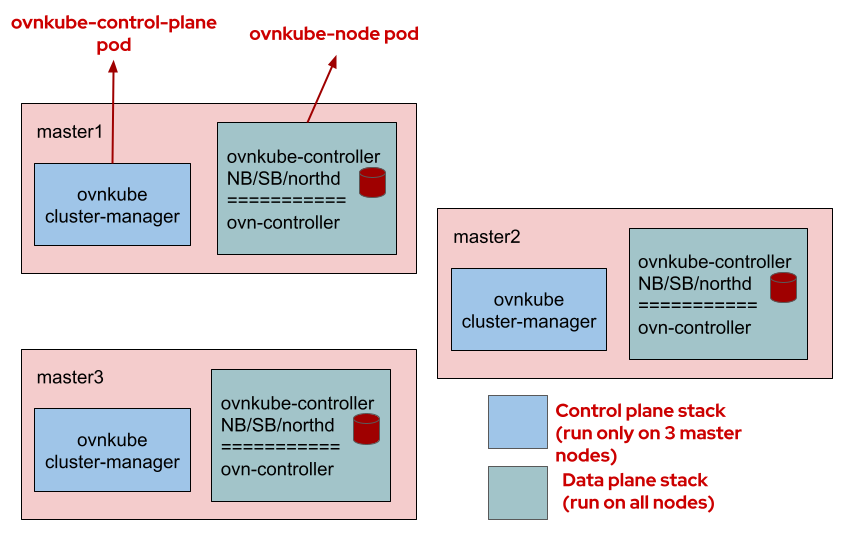
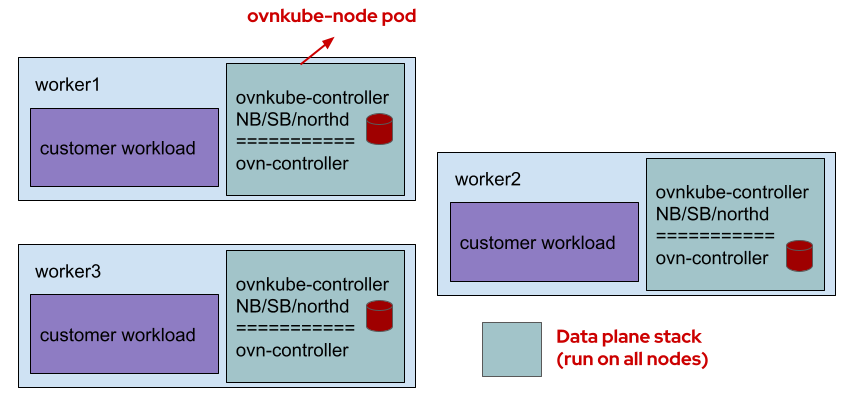
know the pods and components running in the interconnect mode, let's tie up loose ends and
show how these components run on a standard HA Kubernetes cluster. By default, each node in
the cluster is a zone, so each zone contains 1 node. There is no more RAFT since each
node has its own database.
Control Plane Nodes:
Worker Nodes:
Why do we need Interconnect mode in OVN-Kubernetes?
This architecture brings about several improvements:
- Stability: The OVN Northbound and Southbound databases are local to each node. Since they are running in the standalone mode, that eliminates the need for RAFT, thus avoiding all the “split-brain” issues. If one of the databases goes down, the impact is now isolated to only that node. This has led to improved stability of the OVN-Kubernetes stack and simpler customer escalation resolution.
- Scale: As seen in the above diagram, the ovn-controller container connects to the local Southbound database for logical flow information. On large clusters with N nodes, this means each Southbound database is handling only one connection from its own local ovn-controller. This helps OVN-Kubernetes scale horizontally with node count.
- Performance: The OVN-Kubernetes brain is now local to each node in the cluster, and it is storing and processing changes to only those Kubernetes pods, services, endpoints objects that are relevant for that node (note: some features like NetworkPolicies need to process pods running on other nodes). This in turn means the OVN stack is also processing less data thus leading to improved operational latency. Another benefit is that the control plane stack is now lighter-weight.
- Security: Since the infrastructure network traffic between ovn-controller and OVN Southbound database is now contained within each node, overall cross-node and cross-cluster (HostedControlPlane, ManagedSaaS) chatter is decreased and traffic security can be increased.